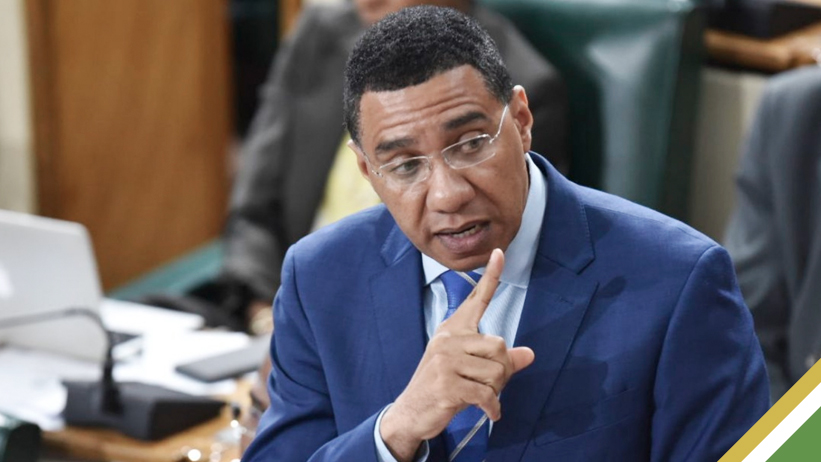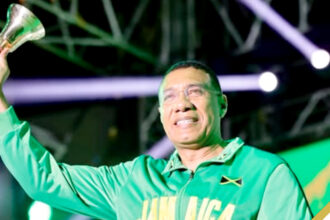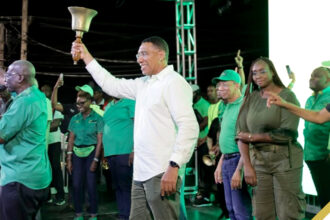







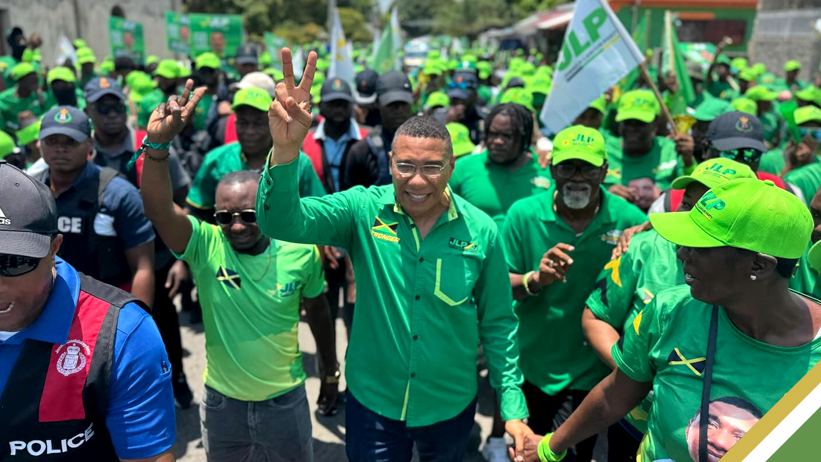

The national minimum wage will be doubled to J$32,000 per 40-hour work week “over the next few years” starting next year—if the Jamaica Labour Party (JLP) is returned to power. That was the pledge made by JLP Leader and Prime Minister Dr Andrew Holness as he addressed thousands of supporters during a mass meeting along Old Harbour Road in Spanish Town, St Catherine, on Sunday night.
Holness revealed that the current minimum wage of J$16,000 will first move to J$18,500 in the administration’s next budget, which traditionally takes effect April 1 each year. From there, he said, the increases will be rolled out gradually until the new J$32,000 target is reached. “By increasing the minimum wage gradually you shift the incentive to work in favour of work, so you going to get more Jamaicans voluntarily move out of the unemployment pool into the labour pool,” he explained, describing the plan as both necessary and strategic.
The Prime Minister argued that Jamaica’s economic landscape has changed, pointing to the country’s historically low 3.3 per cent unemployment rate as a game-changer. “At 3.3 per cent unemployment, you are practically at full employment,” Holness noted. “People are not making decisions to leave what they are doing; many of them are at home, many of them are at the street side, some of them are hustling, and so the incentive to work at that level (current minimum wage) is not strong enough.”
Holness emphasized that the measure is not only about wages but about stimulating broader economic growth. He insisted that his government’s approach over the past nine years has been to carefully build “a finely-tuned economic engine” without sudden shocks. “You can’t mek any big swing. Everything you do you have to plan it out over a period of time and that is how we have managed to keep everything stable without asking you to pay any more taxes,” he told supporters.
By tying wage reform to Jamaica’s low unemployment rate and his administration’s record of economic stability, Holness positioned the proposal as both a reward for workers and a strategy to strengthen the country’s labour force. With the general election looming this Wednesday, the promise has set the stage for one of the most consequential policy debates of the campaign.